What Is AEO (Answer Engine Optimization)?
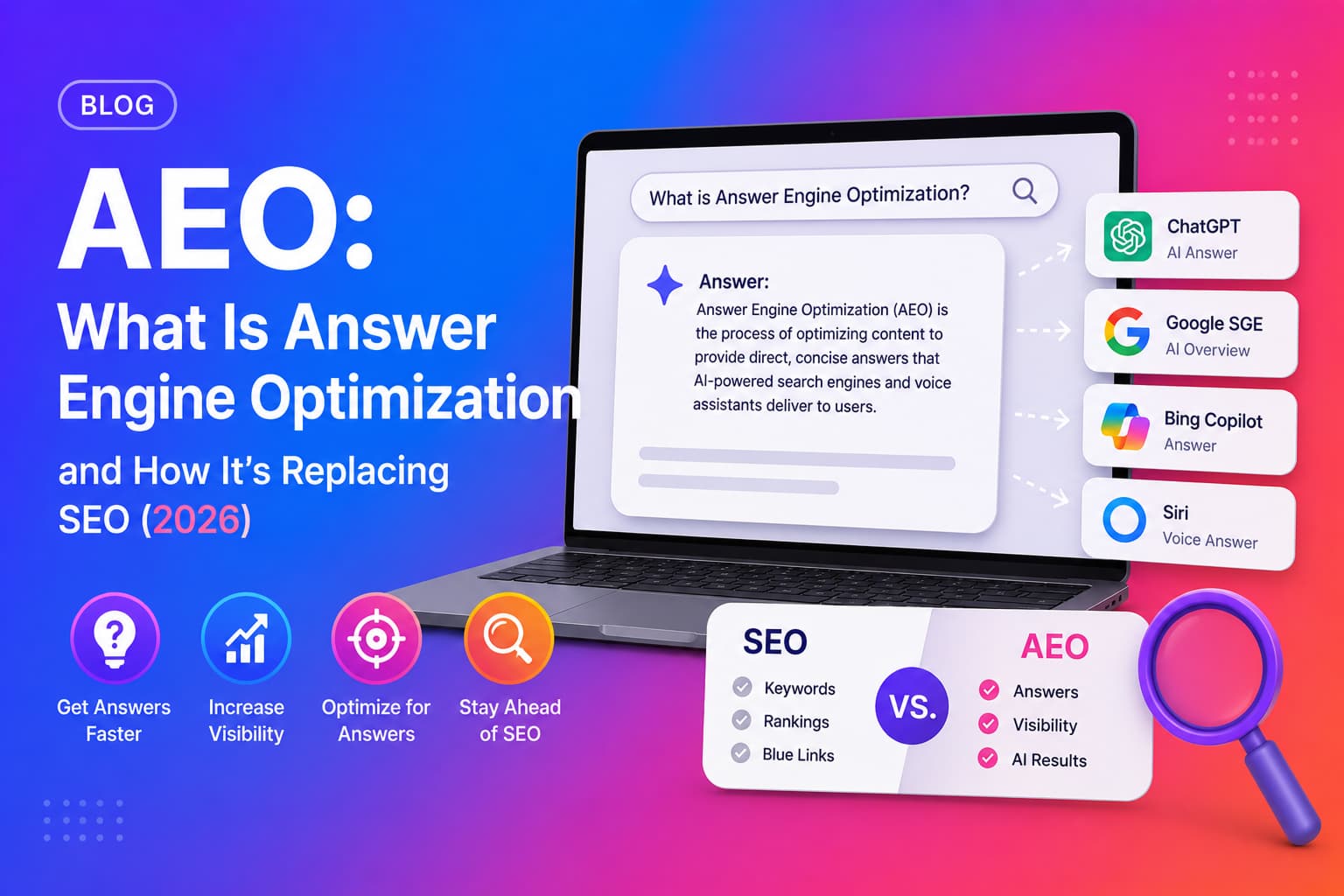
Answer Engine Optimization — AEO — is the practice of structuring your content so that AI-powered search engines select it as a direct answer to a user's question. Instead of optimizing for a ranking position in a list of links, AEO optimizes for citation: being the source an AI model quotes, summarizes, or displays directly.
The term emerged as Google AI Overviews, ChatGPT Search, Perplexity AI, and YouTube's AI-powered search began answering questions directly — without requiring the user to click through to a website. When AI gives the answer, only the sources it cites receive traffic. Everyone else gets nothing.
The core shift
Traditional SEO: rank in position 1–10, hope the user clicks your link. AEO: become the answer itself. The difference is whether AI treats your content as a source worth citing — or ignores it entirely.
How AEO Differs from Traditional SEO
Traditional SEO and AEO are optimizing for fundamentally different outcomes. Understanding the difference is essential before deciding where to invest your time.
Traditional SEO
- check_circleGoal: rank in the top 10 results on a search engine results page (SERP).
- check_circleTraffic model: user sees a list of links, clicks one, lands on your page.
- check_circleSuccess metric: organic search clicks and keyword rankings.
- check_circleContent format: keyword-optimised articles, pages, and product listings.
- check_circleKey signals: backlinks, domain authority, on-page keywords, page speed.
AEO (Answer Engine Optimization)
- check_circleGoal: be cited as a source by an AI model answering a user's question.
- check_circleTraffic model: AI cites your content directly — some users click through, many do not.
- check_circleSuccess metric: citation frequency, brand mentions in AI answers, featured snippet ownership.
- check_circleContent format: structured, question-focused, authoritative answers in clear prose.
- check_circleKey signals: E-E-A-T (Experience, Expertise, Authoritativeness, Trustworthiness), structured data, FAQ markup, clear definitions.
The critical difference
- arrow_rightSEO wins you a position in a list — users still choose whether to click.
- arrow_rightAEO wins you the answer itself — AI already made the choice before the user sees the result.
- arrow_rightIn AEO, position 1 no longer exists. There is only: cited or not cited.
- arrow_rightA page ranking #1 in traditional SEO can still be ignored by AI if it is not formatted for extraction.
Why Answer Engines Are Replacing Traditional Search in 2026
The shift from search to answers has been accelerating since 2023, but 2026 is the year it became impossible to ignore. Several forces are driving this change simultaneously.
Google AI Overviews took over the top of the page
Google's AI Overviews now appear at the top of search results for the majority of informational queries. The AI answer occupies the prime real estate where position 1 used to be — and it pushes all blue links below the fold. Studies show that AI Overview results receive the majority of attention, while organic results below see significantly reduced click-through rates.
ChatGPT, Perplexity, and Gemini are capturing search intent
A growing share of search — particularly for how-to, comparison, and research queries — is now going directly to ChatGPT, Perplexity, Google Gemini, and Claude instead of traditional search engines. These tools answer the question conversationally, citing a handful of sources. If your content is not one of those sources, you receive zero traffic from that intent.
Zero-click searches have reached a tipping point
A zero-click search is one where the user gets their answer directly from the search results page — without clicking through to any website. In 2026, the majority of Google searches end without a click. Traditional SEO optimizes for a click that increasingly never happens. AEO optimizes for being cited in the answer that replaced the click.
Voice and assistant search is inherently AEO
When a user asks Siri, Google Assistant, Alexa, or a smart speaker a question, they receive one answer — not a list of links. There is no page two. There is no second opinion. The AI picks one source and reads it aloud. Voice search is pure AEO: either your content is the answer, or it doesn't exist for that query.
The Major Answer Engines in 2026
AEO is not a single channel — it is a strategy that applies across every platform where an AI is selecting and presenting answers. These are the answer engines that matter most in 2026:
Google AI Overviews
The most important answer engine for most content creators and businesses. Google AI Overviews appear at the top of search results for informational queries and cite 3–5 sources. Being cited in Google AI Overviews requires content that is structured, authoritative, and directly answers the query — not content built solely around keyword density.
YouTube
YouTube is the second-largest search engine in the world — and it is becoming a primary answer engine. When users search YouTube, they expect a video that directly answers their question, not a ranked list to browse. YouTube's AI surfaces relevant videos based on how well the content addresses the search query — which means chapter titles, transcripts, and descriptions are all AEO signals. Google also pulls YouTube videos directly into AI Overviews as cited video sources.
ChatGPT Search
ChatGPT now has a native search capability that browses the web and cites sources. When users ask ChatGPT a question, it returns a synthesized answer with citations. Content that is clearly written, well-structured, and published on authoritative domains is more likely to be selected as a citation source.
Perplexity AI
Perplexity is an AI-native search engine that answers questions with inline citations. It is rapidly growing as a research and discovery tool, particularly among professionals and tech-savvy users. Perplexity prioritizes concise, factually accurate, clearly structured content — making AEO the primary optimization strategy for content targeting its users.
Voice Assistants and Smart Speakers
Siri, Google Assistant, Alexa, and Cortana all operate as pure answer engines. They select one answer and deliver it verbally. Conversational, clearly formatted, question-and-answer structured content performs best for voice search — which overlaps almost entirely with AEO best practices.
YouTube is your most powerful AEO asset
A well-optimized YouTube video can appear as a cited source in Google AI Overviews, rank in YouTube's own search, and be pulled into voice answers. It is the one content format that feeds multiple answer engines simultaneously — making YouTube AEO one of the highest-leverage strategies in 2026.
How to Optimize Content for AEO: 8 Strategies That Work in 2026
AEO is not a single tactic — it is a content philosophy. These are the eight strategies that determine whether AI treats your content as a citation-worthy source.
1. Answer the question directly in the first paragraph
AI models extract answers by finding the most direct, accurate response to a query. Content that buries the answer in paragraph 5 after a long preamble will lose to content that states the answer clearly in the opening sentence. Write your content like an encyclopedia entry, not a blog story: answer first, context second.
2. Use structured question-and-answer formatting
FAQ sections are among the most cited content in AI answers. When you write a question as a heading (H2 or H3) followed immediately by a direct answer, AI models can extract that pair cleanly. Every piece of content targeting AEO should include a well-written FAQ section with real questions users type into search engines.
3. Add structured data markup (Schema.org)
Schema markup tells Google exactly what your content is: a FAQ, a how-to guide, a product, a recipe, a definition. FAQPage schema, HowTo schema, and Article schema all increase the probability of your content appearing in AI Overviews and rich results. This is one of the highest-leverage technical AEO tactics available.
4. Build E-E-A-T signals into every page
Google and other AI engines prioritize sources that demonstrate Experience, Expertise, Authoritativeness, and Trustworthiness (E-E-A-T). This means: author bylines with real credentials, original research or data, links from authoritative domains, and content that reflects genuine first-hand knowledge — not recycled summaries. AI models are trained to recognize and prefer high E-E-A-T content.
5. Write at the right depth — comprehensive but scannable
AI models need enough information to trust your content as authoritative — but they extract answers in short, scannable chunks. The ideal AEO content is comprehensive in coverage (covers every aspect of the topic) but modular in structure (each section answers one question independently). A reader — or an AI — should be able to jump to any section and get a complete answer without reading the whole piece.
6. Target question-intent keywords
Traditional SEO often targets short-tail keywords: "YouTube SEO", "title generator", "hook script". AEO targets question-intent keywords: "What is AEO?", "How does answer engine optimization work?", "Will AEO replace SEO?". These are the exact phrases users type into AI tools — and they are the queries you need to appear in to win AEO citations.
7. Optimize for featured snippets first
Google's featured snippet — position zero in traditional search — is the direct predecessor of AI Overviews. Content that wins featured snippets is the same content that gets cited in AI Overviews. If you can answer a question in 40–60 words with a clear definition, step list, or comparison table, you are already writing AEO-ready content.
8. Optimize your YouTube videos for AEO
YouTube videos are increasingly cited in Google AI Overviews as video sources. For a YouTube video to be selected as an AI citation, it needs: a title that directly matches the search query, chapter timestamps that break the video into searchable topics, a transcript-derived description with keyword-rich content, and chapter titles that Google can index independently. Every chapter title is a separate AEO signal.
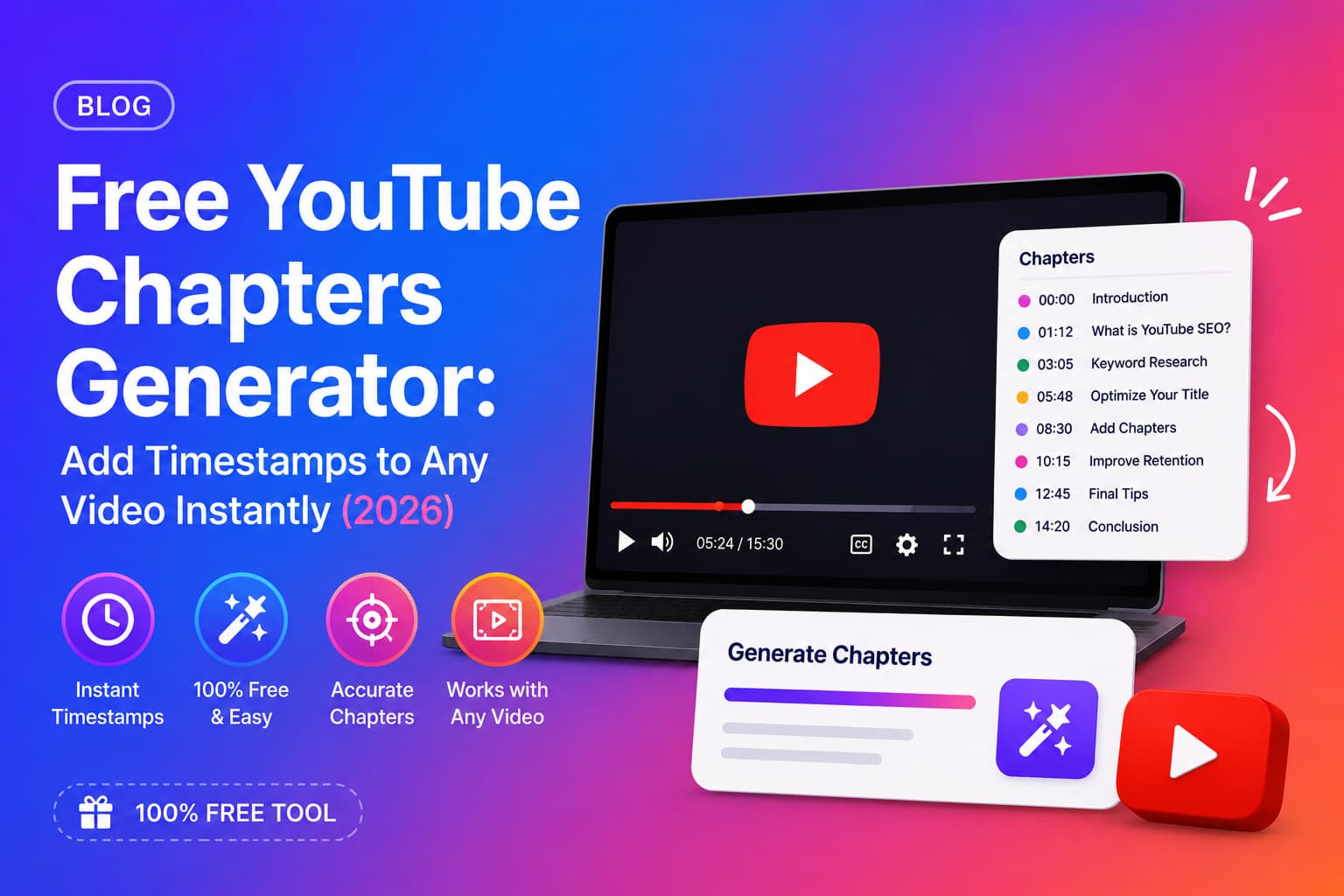
YouTube chapter titles are indexed individually by Google and cited in AI Overviews. Learn how to generate them automatically with our YouTube chapters generator guide .
YouTube AEO: Why Video Is the Most Powerful Answer Engine Channel
Most AEO guides focus entirely on written content. But YouTube is arguably the highest-leverage AEO channel available to most creators and businesses in 2026 — for three reasons.
YouTube videos appear directly in Google AI Overviews
Google regularly cites YouTube videos as sources in AI Overview answers. When a user searches a how-to or explanatory query, Google may embed a relevant YouTube video directly in the AI answer — alongside text citations. A well-optimized video with strong chapter timestamps, a keyword-rich title, and a transcript-based description has a meaningfully higher chance of being selected.
Each chapter title is a separate AEO ranking signal
Google indexes YouTube chapter titles individually as "Key Moments" in search results. A 10-chapter video produces 10 separate AEO signals — each chapter title can appear as a cited answer for a different query. No other single piece of content gives you this kind of multi-query AEO coverage from one asset. This is why chapter optimization is one of the highest-impact YouTube tactics in 2026.
YouTube is its own answer engine
When someone types a question into YouTube search — "how to add chapters to YouTube", "best YouTube SEO strategy", "what is AEO" — they are treating YouTube exactly like a search engine. YouTube's algorithm selects the video most likely to answer the query correctly, based on title relevance, transcript content, watch time, and engagement. Optimizing for YouTube search is AEO, not traditional SEO.
The AEO multiplier effect
A single YouTube video optimized for AEO can: (1) rank in YouTube search for multiple queries, (2) appear as a cited video source in Google AI Overviews, (3) have individual chapters appear as Google "Key Moments" rich results, and (4) be cited verbally by voice assistants for how-to queries. No other content format delivers this reach from one asset.
AEO vs SEO: Should You Choose One or Both?
The honest answer is: AEO is not fully replacing SEO in 2026 — but it is rapidly outpacing it for informational and how-to queries. The right strategy depends on what you are optimizing for.
Where traditional SEO still wins
- check_circleTransactional queries — "buy", "pricing", "book a demo" — AI sends users to websites because they need to complete an action.
- check_circleLocal search — "pizza near me", "plumber in London" — still generates map pack and click-through traffic.
- check_circleE-commerce — product pages, category pages, and price comparison queries still drive traditional click traffic.
- check_circleBrand and navigational queries — users searching for a specific company or tool name will still click through.
Where AEO wins decisively
- check_circleInformational queries — "what is", "how does", "why does" — AI delivers the answer directly. Traditional SEO clicks on these queries have collapsed.
- check_circleHow-to queries — step-by-step instructions are extracted and displayed in AI Overviews. Blue links are rarely clicked.
- check_circleComparison queries — "X vs Y" answers are synthesized by AI and presented with cited sources.
- check_circleDefinition queries — AI defines terms directly. The cited source gets the brand attribution, not a click.
- check_circleResearch and learning queries — users asking AI to explain a topic get a comprehensive answer with citations. Your content needs to be one of those citations.
The practical strategy for 2026
- arrow_rightUse AEO for informational, how-to, and educational content — this is where AI has the most impact.
- arrow_rightUse traditional SEO for transactional, local, and navigational content — clicks still happen here.
- arrow_rightBuild YouTube AEO as a standalone channel — video is uniquely placed to win across both.
- arrow_rightDo not abandon backlinks and domain authority — they still influence which sources AI trusts and cites.
- arrow_rightTreat FAQ sections and structured data as non-negotiable — these are the bridge between SEO and AEO.
How to Measure AEO Performance
AEO success is harder to measure than traditional SEO because citations do not always generate clicks. These are the metrics that matter:
- check_circleAI Overview citations — use Google Search Console to monitor which queries trigger AI Overviews and whether your content is cited. Track impressions even when clicks are zero.
- check_circleFeatured snippet ownership — track how many featured snippets your content holds. Featured snippets and AI citations come from the same pool of content.
- check_circleBrand mentions in AI answers — manually test your key queries in ChatGPT, Perplexity, and Google to see if your content is cited. Track this weekly.
- check_circleYouTube Key Moments — check Google Search Console for video impressions via chapter "Key Moments" rich results.
- check_circleDirect traffic and branded search — when AI mentions your brand without a link, users often search your brand name directly. Rising branded search traffic is an AEO signal.
- check_circleClick-through rate from AI citation traffic — when you are cited, what percentage of users click through? This tells you how compelling your citation snippet is.
The AEO Content Checklist for 2026
Before publishing any content in 2026, run it through this AEO checklist:
- 1Does the first paragraph directly answer the primary question without a preamble?
- 2Is the article structured with question-format headings (H2/H3) followed by direct answers?
- 3Is there a well-written FAQ section with real user questions as headers?
- 4Is FAQPage or HowTo structured data markup implemented?
- 5Does the content demonstrate genuine expertise or first-hand experience?
- 6Is the author clearly identified with credentials that establish E-E-A-T?
- 7Are definitions clear enough to be read aloud by a voice assistant?
- 8If this is a YouTube video, does it have chapter timestamps with keyword-rich titles?
- 9Does the video transcript include the natural phrasing of the questions users search?
- 10Have you tested the primary query in Google AI Overviews to see who currently owns the citation?
For YouTube AEO specifically, chapter timestamps are the highest-impact signal. See the full guide in our YouTube SEO checklist for 2026 — covering every step from upload to citation.
How Chaptrly Helps You Win YouTube AEO
Chaptrly is designed around the exact content signals that make YouTube videos AEO-ready. Paste any YouTube video URL and Chaptrly reads the full transcript to generate the assets that matter most for answer engine citation.
- check_circleChapter timestamps — keyword-aware, descriptive chapter titles that Google indexes independently as "Key Moments" and cites in AI Overviews.
- check_circle8 SEO title options — each title written to match the exact phrasing users search on YouTube and Google.
- check_circleSEO-optimised description — the first 150 characters written as an AEO-ready answer that summarises the video's core value.
- check_circleKeyword tags — the exact phrases that connect your video to relevant search queries.
- check_circleVideo Score — a graded report on your video's hook, engagement, SEO, and retention signals.
- check_circleHook scripts — the first 30 seconds written to reduce drop-offs and maximize retention (a key AEO ranking signal on YouTube).
Every output Chaptrly generates is built around the content signals that answer engines use to evaluate and cite YouTube videos. The result is a video that is optimized not just for YouTube rankings, but for Google AI Overviews, Key Moments rich results, and voice search citation.